
Shockwave Therapy
Shockwave therapy (SWT) uses focused acoustic sound waves, delivered through the skin with a handheld device, to address pain in muscles, tendons and joints.
Service
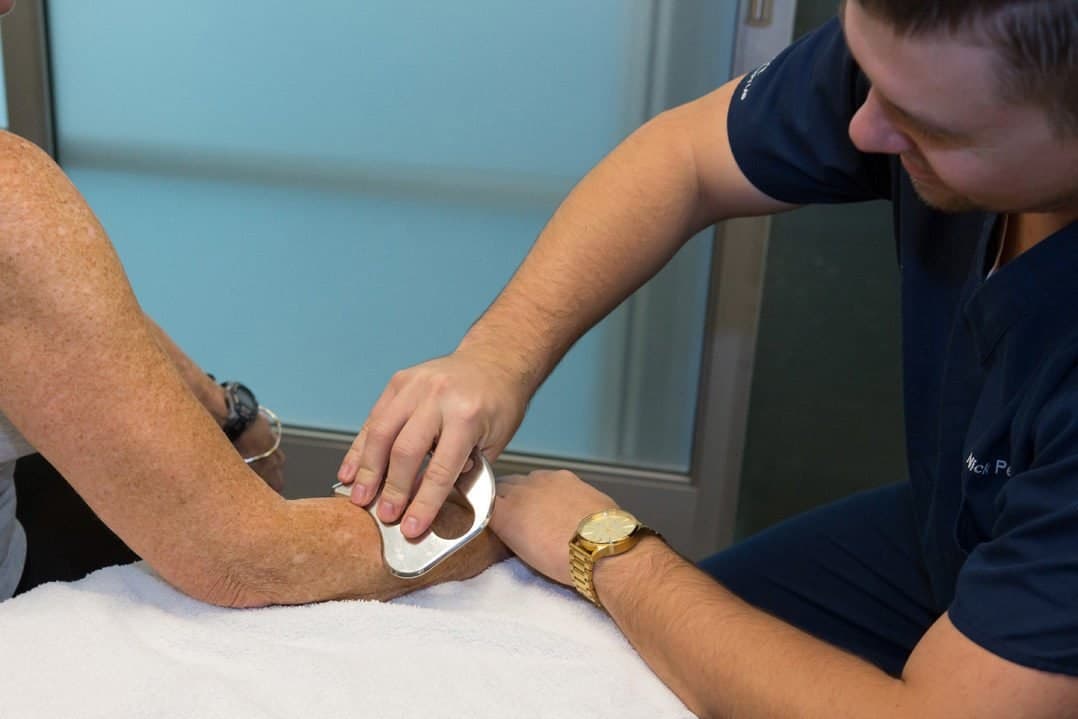
Instrument assisted soft tissue mobilization (IASTM) is a non-invasive, hands-on technique that has grown in popularity with physical therapists, and another option for addressing pain and tightness in the body.
It uses specifically designed instruments to detect and treat fascial dysfunction. The instruments help magnify irregularities in the tissue, such as scars, restrictions, and adhesions in the fascia (the connective tissue that surrounds muscles), making the area easier to locate and treat. Because the tools limit friction, they allow a level of precision, depth, and sensitivity that is hard to reach with hands, knuckles, or elbows alone.
At KOH Physical Therapy Lab, IASTM is used as one part of an individualized plan, often alongside exercise and other treatments such as shockwave therapy, kinesiology taping, fascia stretching, and cold laser therapy. When appropriate, we may offer CBD-infused cream during treatment.
Benefits
Who it is for
The technique
IASTM lets your therapist detect and treat scar tissue and restrictions that affect normal function. Some IASTM systems, such as the Graston Technique, use their own trademarked instruments and methods.
The technique is thought to separate and break down collagen cross-links, and to splay and stretch connective tissue and muscle fibers. It is also thought to increase blood flow to and from the area and increase cellular activity there.
The goal is to start a controlled healing response in the tissue, stimulating the production of new collagen so the area can heal properly.
Background
Scar tissue is a dense, fibrous tissue that everyone has. Its collagen fibers tend to line up in one direction, which makes it less elastic than healthy tissue. As scar tissue builds, muscles can become shorter and weaker, which can lead to less range of motion, loss of strength, pain, tingling, weakness, or numbness.
Scar tissue can form in two ways. The first is when a muscle, tendon, or ligament is torn or crushed: the body forms scar tissue to "glue" the torn pieces together, and this is a necessary part of healing.
The second is when soft tissue does not get enough oxygen, called hypoxia. Poor posture, athletic training, repetitive use, and sustained pressure such as long periods of sitting all increase muscle tension, and higher tension reduces blood supply to the area. Less blood flow means less oxygen, and over time this is thought to encourage scar tissue to form and affect the surrounding muscles, tendons, ligaments, fascia, and nerves.
Research
Research on IASTM is still emerging. A 2016 systematic review of randomized controlled trials found mixed results for musculoskeletal conditions, with some evidence that IASTM can increase joint range of motion in the short term.
One study in that review found that IASTM to the back of the shoulder increased shoulder range of motion in collegiate baseball players. A 2017 review describes studies using IASTM for conditions such as plantar fasciitis, and notes that much of the research so far comes from case reports and animal studies.
Because results vary from person to person, your physical therapist evaluates your condition first and uses IASTM as one part of a broader plan that includes exercise.
Videos
IASTM Anchoring Technique
FAQ
For clinicians
Learn the latest IASTM techniques and expand your scope of practice with the IASTM course offered through AQuire. Improve your hands-on skills and support your patients' care.
Related
Shockwave therapy (SWT) uses focused acoustic sound waves, delivered through the skin with a handheld device, to address pain in muscles, tendons and joints.
Kinesiology therapeutic taping uses an elastic tape applied to specific areas of the body to support muscles, tendons, and ligaments, help relieve pain and swelling, and support athletic performance.
Fascia stretching therapy is therapist-assisted stretching and mobility work for plantar fasciitis, neck pain, and other musculoskeletal conditions. It works on the whole connective tissue system, not just single muscles.
Request an appointment online, or text our scheduling team. Text is the fastest way to reach us.