
Treatments & Techniques
Physical Therapy for Shoulder Pain: Can the Upper Back Help?
Can manipulation of the upper back ease shoulder pain? What recent research shows about thoracic manual therapy, exercise and when to see a PT.
Published
On this page
Shoulder pain can make ordinary tasks feel surprisingly hard: reaching for a high shelf, fastening a seatbelt, sleeping on your side or throwing a ball with your kids. Physical therapy for shoulder pain usually focuses on the shoulder itself, but many people are surprised when their therapist also works on the upper back. Why would a physical therapist mobilize or manipulate the spine between your shoulder blades when the pain is in your arm?
This article looks at what recent research says about spinal and joint manipulation of the thoracic spine (upper and mid back) for one of the most common shoulder problems, subacromial pain syndrome. We cover what the studies found, what it means in plain language, practical steps you can take and when to see a physical therapist.
Why the upper back matters for the shoulder
The shoulder is not one joint. Arm elevation depends on several structures working together:
- The glenohumeral joint, the ball-and-socket joint between the head of the humerus and the glenoid of the scapula (shoulder blade)
- The scapulothoracic articulation, where the scapula glides over the back of the rib cage
- The acromioclavicular and sternoclavicular joints, which connect the clavicle (collarbone) to the scapula and sternum
- The thoracic spine, twelve vertebrae (T1 to T12) that connect to the ribs and form the base the scapula moves on
When you raise your arm overhead, the upper thoracic spine extends slightly, and the scapula rotates upward and tilts backward on the rib cage. The rotator cuff muscles (supraspinatus, infraspinatus, teres minor and subscapularis) keep the humeral head centered in the socket.
"Subacromial pain syndrome" is a broad label for pain at the top and side of the shoulder that is often worse when lifting the arm, and that is thought to involve the rotator cuff tendons and the subacromial bursa beneath the acromion. Older terms include "shoulder impingement" and "rotator cuff tendinopathy," and you may hear any of them.
Because the thoracic spine and rib cage form the platform for the scapula, clinicians have long theorized that a stiff, rounded upper back could change how the shoulder blade moves and contribute to pain. That idea led researchers to test whether treating the thoracic spine helps people with shoulder pain.
What is spinal and joint manipulation?
Physical therapists use two related hands-on approaches:
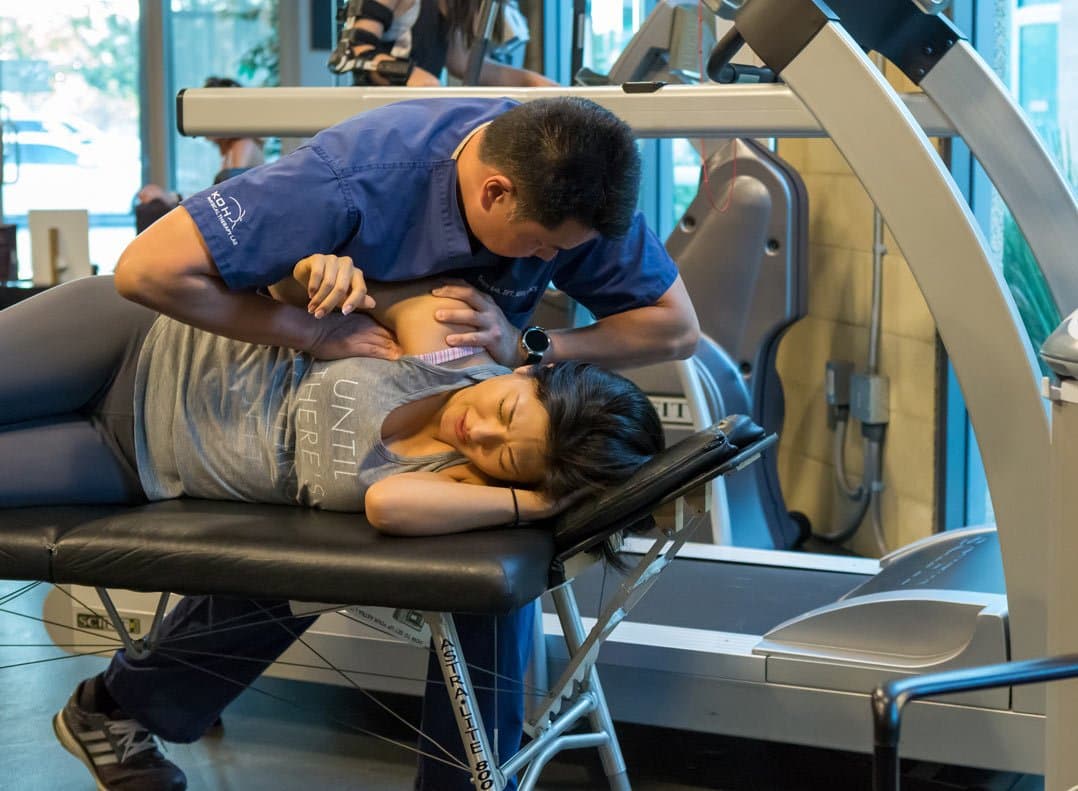
- Thrust manipulation: a quick, small-amplitude movement applied to a joint, sometimes with an audible "pop." The sound is a release of gas within the joint, not a bone moving back into place.
- Nonthrust mobilization: slower, rhythmic movements of different sizes without a quick thrust.
Most researchers now believe the short-term benefits of these techniques come mainly from changes in how the nervous system processes pain and controls muscle tone, rather than from realigning bones. The practical value is that a short window of less pain can make it easier to move and to load the shoulder with exercise.
What the research found
Recent reviews: short-term help, best as part of a broader plan
A 2025 systematic review in the journal Healthcare by Robles-Pérez and colleagues looked at seven randomized controlled trials (RCTs) including 393 adults with subacromial pain syndrome. Across the trials, people improved in pain and disability in the short term. However, thoracic manual therapy on its own rarely outperformed comparison treatments in a consistent way. The more frequent and clinically meaningful improvements appeared when manual therapy was combined with exercise for the thoracic spine. Gains in range of motion were modest. The authors concluded that thoracic care "should be implemented as an adjunct to rehabilitation," not as a stand-alone treatment. They also noted small samples, short follow-up and differences in techniques between studies.
A 2024 systematic review in Manuelle Medizin by Tedeschi and colleagues included nine RCTs on thoracic manual therapy for shoulder impingement. Pain scores generally fell after treatment, and several studies reported better shoulder function, but results were inconsistent. Importantly, the authors noted that most studies found no substantial difference between manual therapy and placebo or sham treatment, and some changes were statistically significant but too small to matter clinically. They described the evidence as limited and suggested manual therapy may be a supplement to standard care.
A landmark trial: manual therapy plus exercise vs exercise alone
One of the larger trials on this question was published in the Journal of Orthopaedic & Sports Physical Therapy (JOSPT) in 2016. Mintken and colleagues randomized 140 people with shoulder pain to either exercise therapy alone or two sessions of cervicothoracic (neck and upper back) manual therapy followed by the same exercise program. Both groups improved substantially in pain and disability, and adding manual therapy did not lead to greater improvement on those measures. However, more patients in the manual therapy group rated their treatment as successful at 4 weeks and at 6 months.
In other words, exercise did the heavy lifting, and manual therapy may have improved how patients felt about their recovery.
Where clinical guidelines fit
In 2025, JOSPT published a clinical practice guideline on rotator cuff tendinopathy by Desmeules and colleagues. It covers assessment, nonsurgical medical care, rehabilitation and return to function and sport for adults with shoulder pain and suspected rotator cuff tendinopathy, including partial-thickness rotator cuff tears. It is a helpful reference for clinicians who want a full, evidence-based picture of care beyond any single technique. (We reviewed the guideline's published abstract; readers interested in the specific graded recommendations should consult the full guideline.)
What this means in plain language
- Upper back treatment can help some people feel better in the short term. The research suggests thoracic manipulation or mobilization may ease pain for a while, but it is not a cure on its own.
- Exercise is the foundation. The most consistent benefits appeared when hands-on care was paired with active exercise, and exercise alone produced substantial improvement in the largest trial.
- The evidence is mixed. Many studies are small and short-term, and several found little difference between real and sham treatment. Your experience may differ from the average result.
- Feeling better matters, too. Even when pain scores were similar, people who received manual therapy in one trial were more likely to rate their care as successful. That can help with confidence and sticking to a program.
- Shoulder pain has many causes. A thorough evaluation should guide whether upper back treatment makes sense for you.
Practical takeaways and best practices
- Keep the shoulder moving within comfort. Complete rest tends to lead to stiffness. Gentle movement and daily activity, adjusted to your symptoms, usually help more than immobilization.
- Build strength gradually. Programs for subacromial pain usually include progressive strengthening of the rotator cuff and the muscles that control the scapula, such as the serratus anterior and the middle and lower trapezius.
- Don't forget the upper back. Thoracic extension and rotation exercises, such as gentle extension over a chair back or a foam roller, may complement shoulder exercise. Ask your therapist which are right for you.
- Pace overhead work. If reaching overhead aggravates your pain, break up tasks, bring items closer and gradually rebuild tolerance rather than avoiding overhead activity entirely.
- Expect a plan, not just a "pop." Hands-on care should come with exercise, education and clear milestones. If you are only receiving passive treatment, ask how you will progress to active rehabilitation.
- Track your progress. Note how easily you can reach overhead, sleep and do daily tasks. These practical markers often matter more than a single pain score.
When to get physical therapy for shoulder pain
Consider physical therapy for shoulder pain if:
- Shoulder pain lasts more than a week or two or keeps coming back
- Pain wakes you at night or makes it hard to lie on that side
- Lifting your arm, reaching behind your back or getting dressed is difficult
- Pain is affecting work, sports, the gym or caring for family
- You want a structured plan to return to overhead activities such as swimming, tennis or throwing
In California, you can see a physical therapist directly without a physician referral (some limits and insurance rules apply).
Seek prompt medical care instead if your shoulder pain follows a fall or significant injury, if you cannot lift your arm at all, if the shoulder looks deformed, or if pain comes with fever, redness and swelling. Seek emergency care if shoulder or arm pain comes with chest pain or pressure, shortness of breath, sweating, nausea or pain spreading to the jaw, as these can be signs of a heart problem.
Shoulder care at KOH Physical Therapy Lab
At KOH Physical Therapy Lab, our physical therapists start with a thorough evaluation of your shoulder, neck and upper back. When appropriate, we combine spinal and joint manipulation or mobilization with a progressive exercise program designed around your goals, whether that is sleeping comfortably, lifting your grandchild or getting back to your sport. Contact us to schedule an evaluation.
References
- Robles-Pérez R, Vallejo-Martínez R, Carrasco-Uribarren A, Jiménez-del-Barrio S, Hernández-Lázaro H, Ceballos-Laita L. Thoracic manual therapy with or without exercise improves pain and disability in subacromial pain syndrome: a systematic review of randomized trials. Healthcare (Basel). 2025;13(19):2479. doi:10.3390/healthcare13192479
- Tedeschi R, Platano D, Melotto G, Danilo D. Effectiveness of manual thoracic therapy in treating impingement syndrome: a systematic review. Manuelle Medizin. 2024. doi:10.1007/s00337-024-01040-6
- Mintken PE, McDevitt AW, Cleland JA, Boyles RE, Beardslee AR, Burns SA, Haberl MD, Hinrichs LA, Michener LA. Cervicothoracic manual therapy plus exercise therapy versus exercise therapy alone in the management of individuals with shoulder pain: a multicenter randomized controlled trial. J Orthop Sports Phys Ther. 2016;46(8):617-628. doi:10.2519/jospt.2016.6319
- Desmeules F, Roy JS, Lafrance S, Charron M, Dubé MO, Dupuis F, Beneciuk JM, Grimes J, Kim HM, Lamontagne M, McCreesh K, Shanley E, Vukobrat T, Michener LA. Rotator cuff tendinopathy diagnosis, nonsurgical medical care, and rehabilitation: a clinical practice guideline. J Orthop Sports Phys Ther. 2025;55(4):235-274. doi:10.2519/jospt.2025.13182
Common questions
Why would a physical therapist treat my upper back for shoulder pain?
The thoracic spine and rib cage form the platform the shoulder blade moves on. When you raise your arm overhead, the upper thoracic spine extends slightly and the scapula rotates upward and tilts backward on the rib cage, so clinicians have long theorized that a stiff, rounded upper back could change how the shoulder blade moves and contribute to pain.
Does upper back manipulation fix shoulder pain on its own?
The research suggests thoracic manipulation or mobilization may ease pain for a while, but it is not a cure on its own. The most consistent benefits appeared when hands-on care was paired with active exercise.
What is the pop during a manipulation?
The sound is a release of gas within the joint, not a bone moving back into place.
Do I need a referral to see a physical therapist for shoulder pain?
In California, you can see a physical therapist directly without a physician referral (some limits and insurance rules apply).
For educational purposes only. This article is general information and is not medical advice. It does not replace an evaluation by a licensed healthcare provider. If you think you are having a medical emergency, call 911.
Watch
Related videos
Shoulder external rotation strengthening
Joint thrust mobility work
From the KOH Physical Therapy Lab YouTube channel. See more exercise and technique videos
Have questions about physical therapy?
Learn more about KOH Physical Therapy Lab services, or request an appointment.