
Treatments & Techniques
Shockwave Therapy, Explained: What It Is, How It Feels and Who It Is For
What is shockwave therapy, does it hurt and what does the research show? Plain answers on focused shockwave for tendon, heel and joint pain.
Published
The name sounds more dramatic than the treatment. Shockwave therapy uses focused acoustic sound waves, delivered through the skin with a handheld device, to address pain in muscles, tendons and joints.
If a heel, elbow or shoulder has been bothering you for a while, you may have come across it. Here are the questions people ask, answered plainly, including what the research supports and what it does not.
On this page
What is shockwave therapy?
Shockwave therapy, also called extracorporeal shockwave therapy (ESWT), was first introduced in 1980 as a non-invasive way to break up kidney stones and gallstones. Extracorporeal simply means the energy comes from outside the body.
Today it is commonly used in physical therapy clinics for pain in the muscles, tendons and joints, including acute and chronic sports and overuse injuries. It offers a non-invasive option for people hoping to avoid surgery or long-term pain medication.
How does shockwave therapy work?
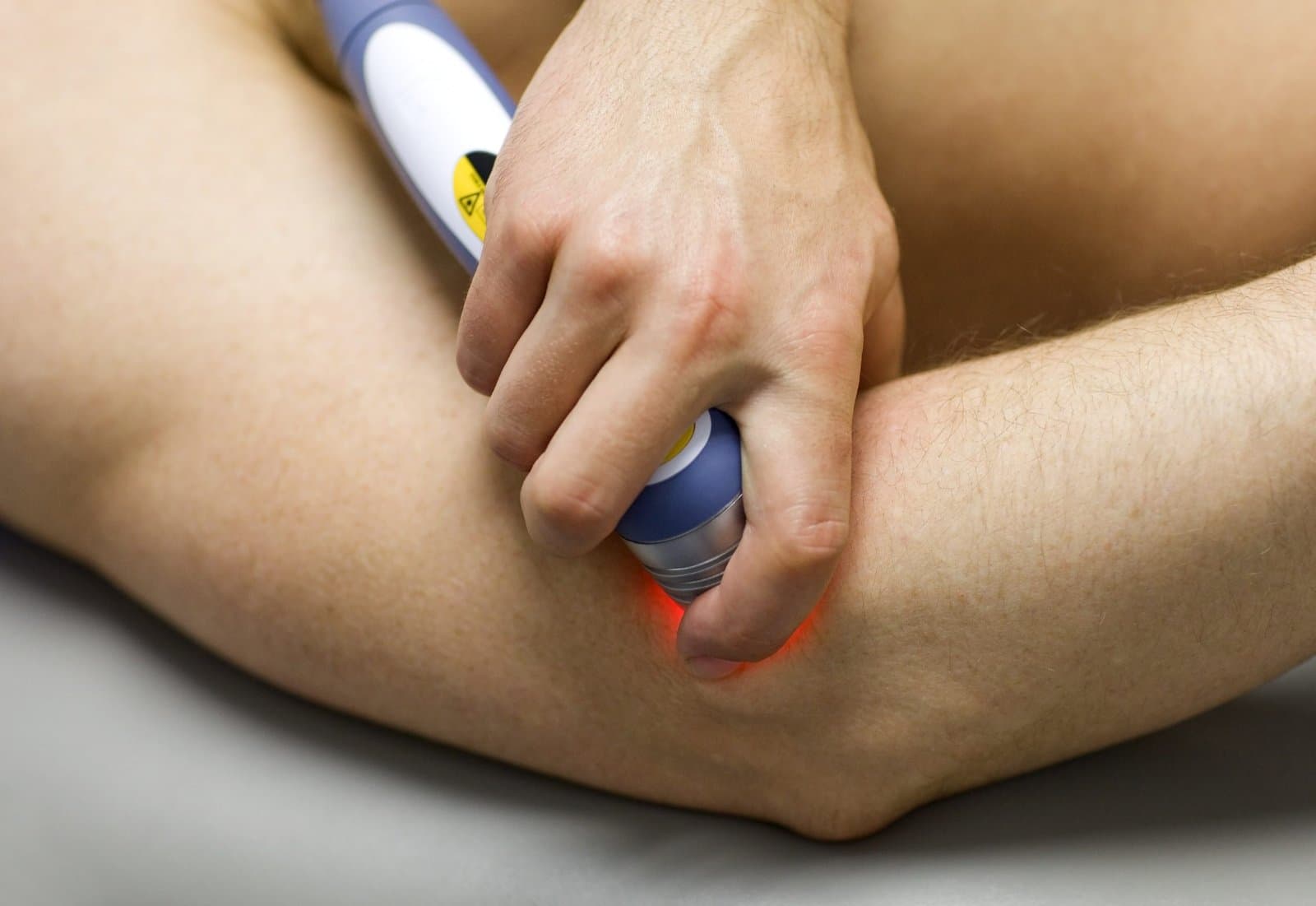
A conducting gel is applied to the skin, and a handheld applicator sends acoustic waves to the target tissue. The waves compress and work the tissue, much like a focused, precise deep tissue massage, which can increase circulation and ease pain.
Cells in tendons, ligaments, bone and blood vessels respond to this kind of mechanical energy, which may increase local blood flow and support the body's repair process.
What is the difference between focused and radial shockwave?
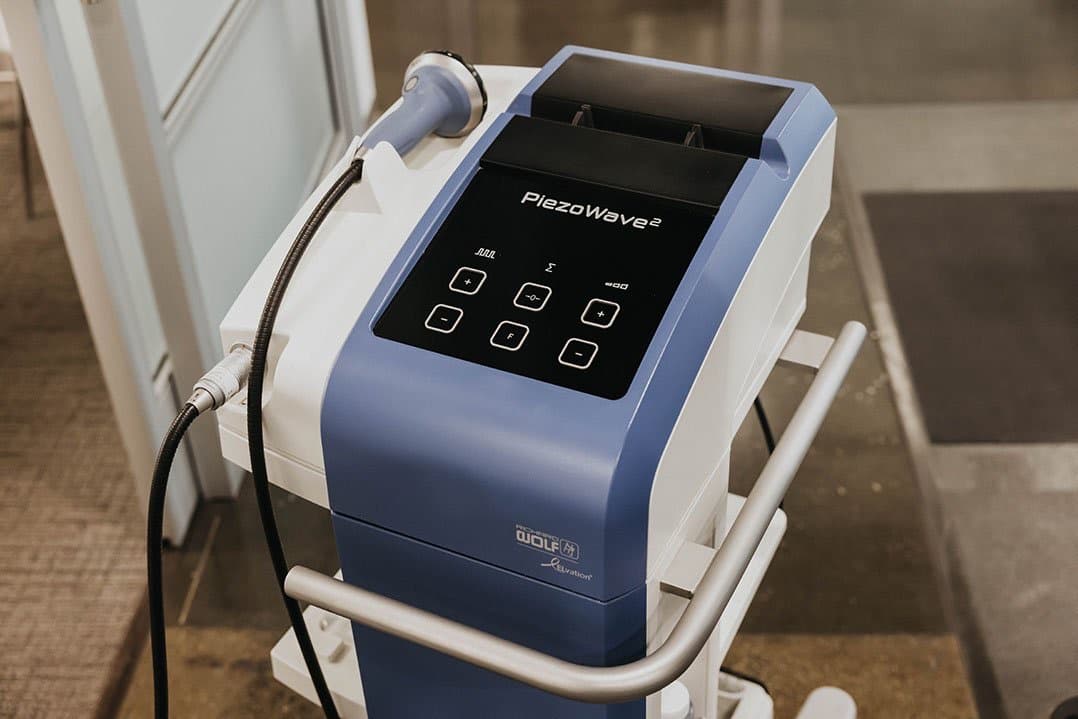
There are two types, and they are not the same thing. Focused shockwaves concentrate energy on specific points and reach deeper tissues. Radial shockwaves spread more widely and mainly reach tissue near the surface.
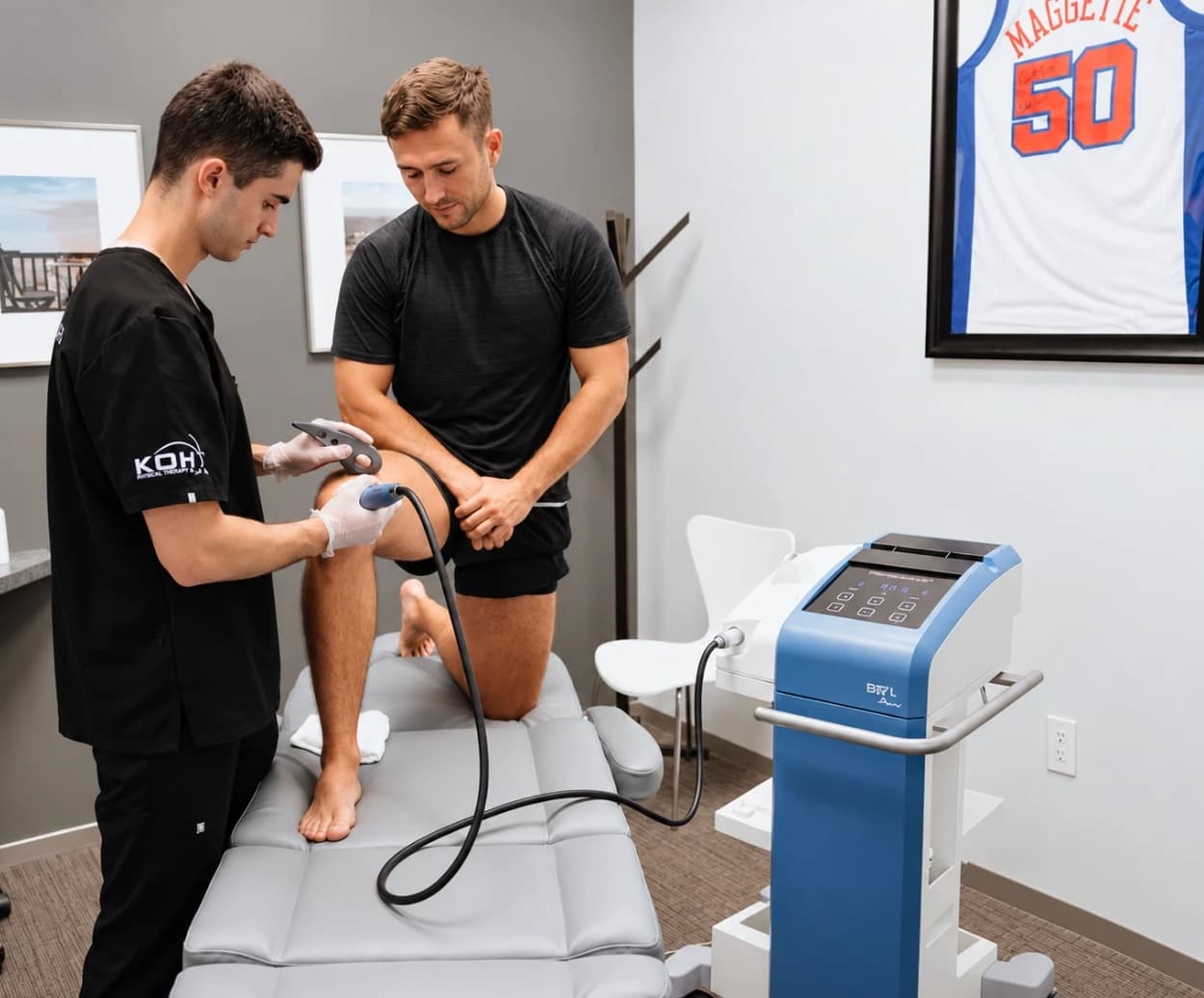
KOH Physical Therapy Lab offers focused shockwave therapy using a PiezoWave2 unit. Your therapist can locate trigger points and deliver focused pulses to the right depth, between about 0.5 millimeters and 3 centimeters depending on the applicator.
What conditions is shockwave therapy used for?
These are the conditions shockwave therapy may help address:
- Tennis elbow and golfer's elbow
- Calcific tendonitis of the shoulder
- Achilles tendinopathy
- Pain on the outside of the hip (greater trochanteric pain syndrome)
- Knee pain around the kneecap (patellofemoral syndrome)
- Shin pain from medial tibial stress syndrome
- Plantar fasciitis, heel pain and foot pain
- Arthritis
- Trigger points and myofascial dysfunction
- Repetitive stress injuries and soft tissue strains in athletes and active people
What does the research show?
The honest answer is that the evidence for shockwave therapy varies by condition. For plantar fasciitis, a 2023 systematic review and meta-analysis found high-quality evidence of a large effect on pain and function. The same review found little or inconclusive benefit for patellar and Achilles tendinopathy.
Also for plantar fasciitis, a 2024 systematic review found that shockwave therapy reduced pain and improved foot function more than corticosteroid injections at three and six months.
It is also used for other tendon conditions, such as tennis elbow and calcific tendonitis of the shoulder, where the evidence differs by condition. That is why it starts with an evaluation: your physical therapist looks at your condition to decide whether shockwave is an option for you.
Does shockwave therapy hurt?
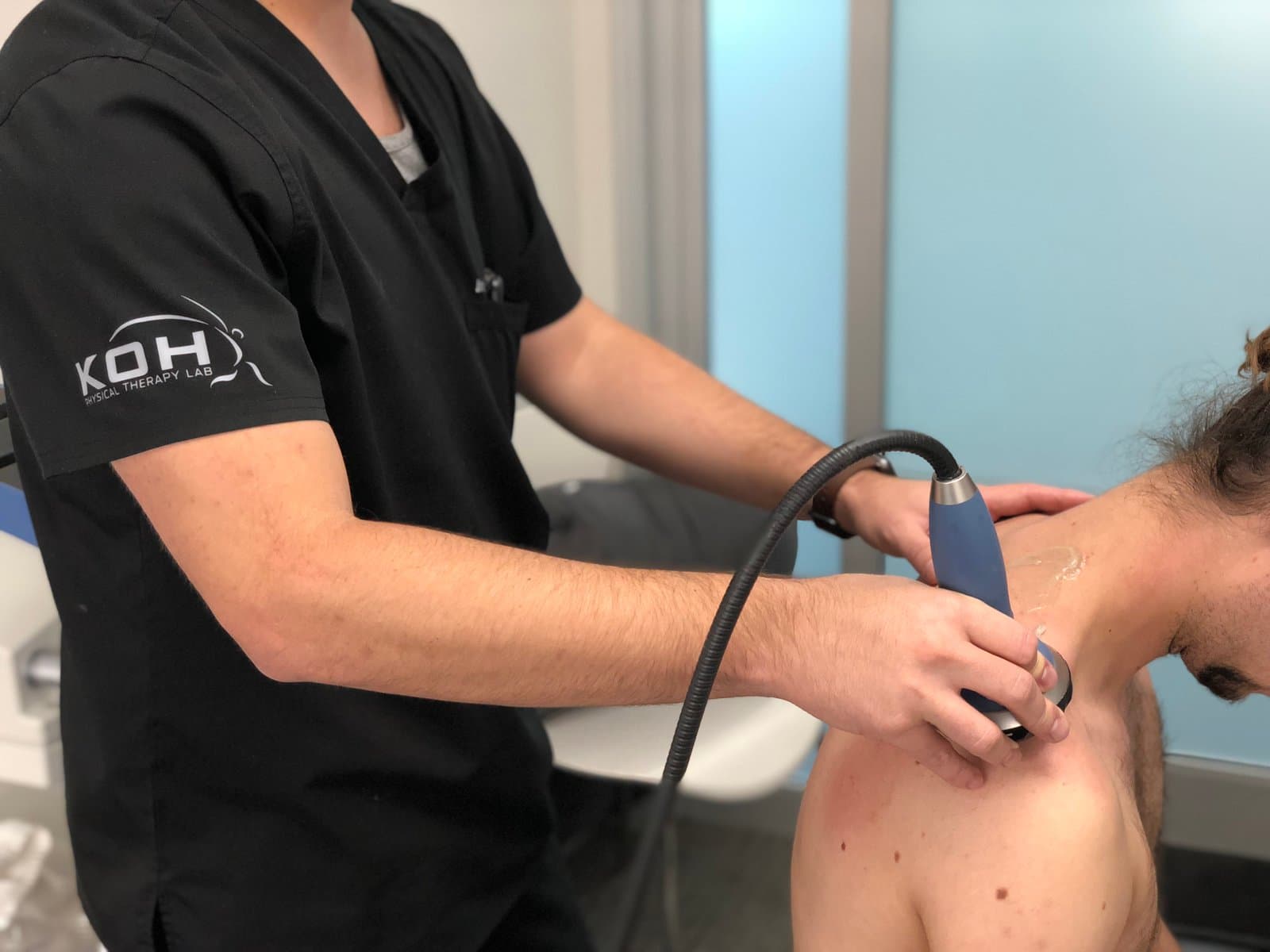
It feels different for everyone, but most people describe it as mild discomfort rather than pain. Bony areas such as the hip tend to be more sensitive than well-cushioned areas such as the calf.
What are the side effects?
Side effects are usually mild and short-lived. In plantar fasciitis studies, the most common were local pain and slight skin redness. Some swelling, bruising or tenderness can appear after a session and usually settles within a few days.
Soreness after treatment is thought to come from the tiny areas of controlled stress the shockwaves create in tissue such as tendon, muscle and bone, which prompt blood flow and cell regeneration.
Who should not have shockwave therapy?
Shockwave is not used during pregnancy, for people with certain heart conditions or a pacemaker, or for people taking medication that affects blood clotting. Your therapist may also avoid it if you have neuropathy or hypersensitivity in the area. You are screened before treatment.
How many sessions will I need?
It depends on the area treated and your medical history. Your therapist discusses a plan with you after your evaluation, reviews your progress, and looks at other possible causes of your symptoms if you are not responding.
Is shockwave used on its own, or with physical therapy?
Either. After your evaluation, shockwave may be a stand-alone plan of care, or your physical therapist may combine it with hands-on treatment and a progressive exercise program, so the treated tissue is loaded and strengthened as it recovers.
It may be considered when tendon or soft tissue pain has lingered, or when earlier care has not been enough.
Can shockwave therapy help with erectile dysfunction?
Low-intensity shockwave therapy is studied for erectile dysfunction (ED). A 2022 American Family Physician review found mild to moderate improvement with no significant side effects, but the American Urological Association considers it investigational, and it is not FDA approved specifically for ED.
At KOH Physical Therapy Lab, it may be recommended and combined with men's pelvic health care. Because erectile dysfunction can be associated with cardiovascular and other health conditions, medical evaluation may also be appropriate.
How do I get started?
Your first visit is an evaluation, where your therapist decides whether shockwave fits your condition. For more information, including pricing, text or call KOH Physical Therapy Lab at (949) 540-5641.
Common questions
Is shockwave therapy painful?
It feels different for everyone, but most people describe it as mild discomfort rather than pain. Bony areas such as the hip tend to be more sensitive than well-cushioned areas such as the calf. Some soreness, minor swelling, bruising or tenderness in the treated area for a few days afterward is common.
Who should not have shockwave therapy?
Shockwave is not used during pregnancy, for people with certain heart conditions or a pacemaker, or for people taking medication that affects blood clotting. Your therapist may also avoid it if you have neuropathy or hypersensitivity in the area. You are screened before treatment.
How many shockwave sessions will I need?
It depends on the area treated and your medical history. Your therapist discusses a plan with you after your evaluation, reviews your progress, and looks at other possible causes of your symptoms if you are not responding.
Does KOH Physical Therapy Lab use focused or radial shockwave?
Focused. We use a PiezoWave2 focused shockwave unit, which concentrates energy on specific points and reaches deeper tissue. Radial shockwave spreads more widely and mainly reaches tissue near the surface.
For educational purposes only. This article is general information and is not medical advice. It does not replace an evaluation by a licensed healthcare provider. If you think you are having a medical emergency, call 911.
Watch
Related video
Soft tissue work and acoustic compression on a hamstring tendon
From the KOH Physical Therapy Lab YouTube channel. See more exercise and technique videos
Have questions about physical therapy?
Learn more about KOH Physical Therapy Lab services, or request an appointment.